


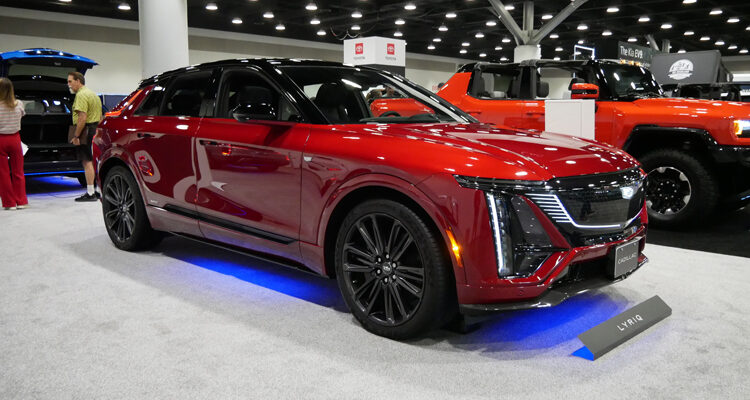
Vancouver, BC — If autonomy and electrification continue to be the harbingers of the next frontier of consumer cars and transport, then General Motors is jumping in with both feet. Well, one could argue that they’ve been swimming in the pool since at least 2017, when the first generation of their Super Cruise autonomous/handsfree technology debuted on the Cadillac CT6 sedan.
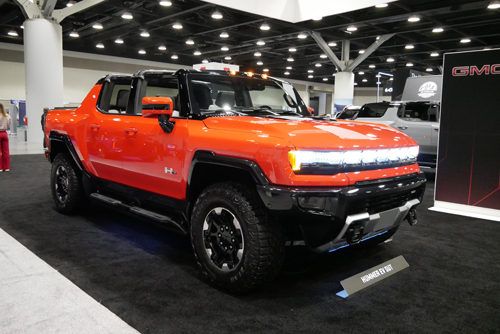
Since then, there have been iterative updates, new versions and more and more roads mapped, to the point that now 950,000 KM worth of roads in Canada and the US have been mapped with lidar technology. We caught up with them at the Everything Electric show in Vancouver to talk all things autonomy and EV.
“Part of the major increase in roads comes down to what we call major and tertiary roads,” said Adam Rodriguez, Executive Director of AV Product Management at General Motors. Gone are the days where Super Cruise was restricted to divided highways with no level crossings; now, country roads, mountain passes and more can all be navigated with the tech.
Indeed, it has been some time coming and will be some time more before it extends beyond North American borders. But it’s for good reason.
“Our approach to autonomy is…we’re only going to launch this when we’re entirely confident that it is going to be safe and performant,” said Rodriguez. “We’re not trying to launch this globally. We’re trying to launch it almost locally and say ‘we’re going to build the best product for the (North American) customer. And then we’ll build on that.’”
“When that light bar turns green, that’s our contract with the customer.” By “light bar”, Rodriguez, is referring to the bad of LEDs atop any vehicle equipped with Super Cruise tech. When they shine green, that’s an indication that you’re on a Super Cruise-eligible road. Then, it’s a press of a button to activate cruise and you’re on your way.
Not only will your Chevy Silverado EV with Super Cruise keep in its lane and clear of the vehicle ahead, it can change lanes for you (without your even asking it, in some cases; say, when approaching slower traffic), read when traffic’s approaching from behind and you need to get out of the way as well as handle itself when navigating construction zones. Indeed, a recent drive in a Silverado EV had us driving for 80 miles in midday central Michigan with no hands on the wheel, and no feet on the pedals. Part of the latest updates to the tech involves integration with Google Maps, which now displays which roads are Super Cruise ready by marking them with a white line on the display map. You can’t yet tell Google to only use Super Cruise equipped roads, but that tech will likely be arriving as the system continues to evolve.
In an interesting twist, however, one of the latest developments in Super Cruise tech involves a touch of the new and a touch of the old. In the “new” corner, Super Cruise can now work when trailering. When a vehicle doubles in length, the cameras and sensors used to ensure it can perform autonomously need to recalibrate. Which they can do, all on their own. No need to program a trailer length or load a profile; the gear on-board can see all that.
The second advancement is actually a little more retro. Used to be that no form of autonomy would work on rural roads – say, those between a farmer’s fields, traversed every day – but now, while full Super Cruise hasn’t quite canvassed all of this, the tech required for Super Cruise to work can now be applied to offer lane centering and steering assist on those road types.
The next frontier? Well, the obvious answer is full autonomy, but hurdles remain; Super Cruise still won’t work in cities or most towns – Rodriguez, who used to work at the Waymo robotaxi company says that inner-city autonomous vehicles remain prohibitively expensive and way out of the purview of most motorists – and edge cases are still a concern. We’re not talking about distracted pedestrians; today, autonomous emergency braking systems have the benefit of being able to see hundreds of metres – even kilometres – ahead and start looking for potential dangers. It’s the minutiae we need to work on.
“It’s raining. It’s night time. An elk crosses the road, and you happen to lose power,” suggests Rodriguez. “How do you solve for that? You need billions of miles of validation.” With enhances in AI and machine learning, however, Rodriguez is confident we’ll get there. Which we may, but as an enthusiastic driver himself (who happens to regularly pilot a Cadillac CT4-V Blackwing performance sedan – as you do), Rodriguez is convinced that there will still be plenty of traditional driving to be done.
“There are times where you want to hit that “V” button, and you want to feel it,” he says. “But then, there are times that you won’t, where you want it to be relaxed and just ‘get me to work in a comfortable way.’”
Electric Frontier
It’s no fluke that while there are plenty of gas-powered GM products that offer Super Cruise, the vehicles that have featured in this story are EVs. That’s because as much as battery-electric vehicles have taken a hit lately, well, no one’s told GM.

On the macro level, 1 in 4 EVs on the road in Canada is a GM, while on the micro level their Chevrolet Equinox EV has been the number one selling EV in Canada for three quarters, helped by the fact that it’s the most affordable EV capable of over 500 KM for sale in Canada. According to Shane Peever, Vice President of Sales and Marketing at GM Canada, it’s Cadillac’s numerous EV offerings – five of them in 2025 – that have helped achieve a 60 per cent conquest rate, with luxury buyers leaving the likes of BMW and Mercedes-Benz for Cadillac.
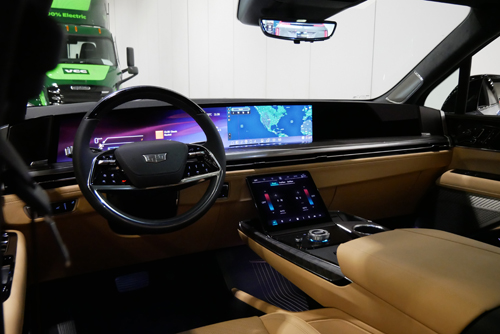
“The ability to attract new buyers for Cadillac is off the charts compared to what we’re seeing from ICEs,” he says. “People that have come to EVs are staying. They’re not going back to ICE.” He credits the fact that EVs are inherently fast, quiet and comfortable to drive – all factors that fit the Cadillac brand well, along with superior build quality, materials used, and tech – such as 33” digital displays, Super Cruise and full-scale Dolby Atmos sound with over 20 speakers, in some vehicles.
Which is all well and good, but Peever admits that as successful as the Equinox EV and the Cadillac stories have been, in order for EV adoption to really take hold it’s coming time to move down market a little. “If you’re going to get mainstream adoption levels, it has to be in segments that are affordable, and to where the average transaction prices for ICE vehicles are.”
In that light, Chevrolet will soon be bringing back the Bolt compact and plans on doubling its EV offerings from 23 next year.
Of course, as we circle back the challenges facing EVs recently – specifically, those of shifting government policy – Peever admits some clarity is needed.
“We’re looking for consistent policy,” he says. “Customers should drive demand, and have a choice.”