


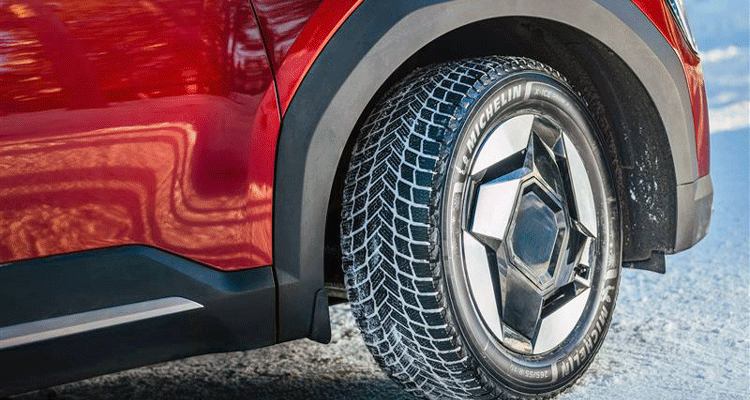
Winter Mastery, Measured in Confidence
Winter tire testing only works when winter shows up without compromise. At Mecaglisse, it always does.
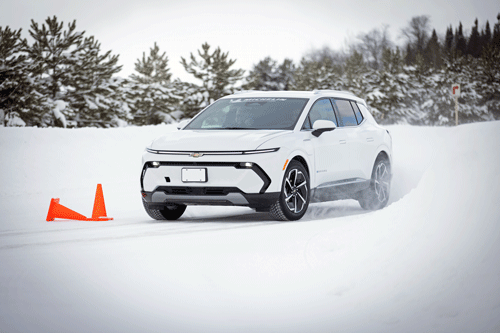
Set in the Laurentians, the proving ground is designed to expose weakness: glare ice polished smooth by repeated laps, deep snow trails winding through dense forest, and mixed-condition road courses where grip changes corner by corner. It’s a place where winter tires don’t get away with vague promises; they either deliver confidence, or they don’t.
For this test, Michelin brought its newest X-Ice Snow+ into a carefully structured comparison against three of the segment’s strongest contenders: the Continental VikingContact 8, Bridgestone Blizzak WS90, and Nokian Hakkapeliitta RS EV. Importantly, not every tire was tested in every scenario. Instead, Michelin focused on targeted, back-to-back comparisons designed to isolate real-world differences rather than blur results through broad generalizations.
Extreme Deep Snow: Michelin vs. Continental
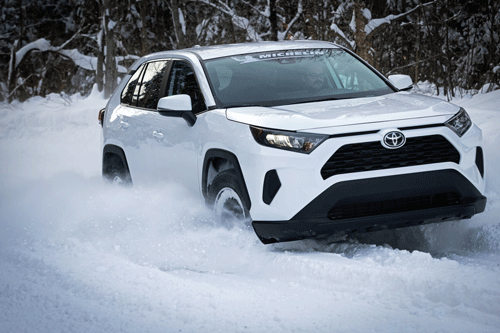
The most demanding environment of the day was the extreme deep-snow off-road course, a wooded trail with unplowed snow deep enough to punish hesitation. In these conditions, testing was conducted exclusively back-to-back between the Michelin X-Ice Snow+ and the Continental VikingContact 8.
From a standstill, the Michelin consistently found traction with less wheelspin and required fewer throttle corrections to maintain forward momentum. Where the Continental occasionally hesitated when asked to climb or pull through rutted sections, the Michelin felt more decisive, delivering smoother acceleration and better self-cleaning as snow packed into the tread.
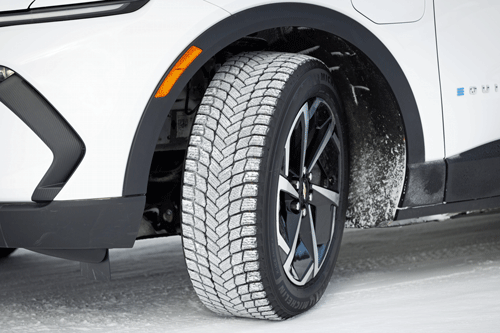
Neither tire struggled outright; both are top-tier winter designs, but the Michelin demonstrated a slight yet repeatable advantage in maintaining composure when momentum dropped. In extreme snow, that margin matters.
Snow and Ice Road Course: Michelin, Continental, and Nokian
On the faster snow-and-ice road course, Michelin broadened the comparison. Here, the X-Ice Snow+ was evaluated against both the Continental VikingContact 8 and the Nokian Hakkapeliitta RS EV, rotating through identical laps to assess braking, turn-in, lateral grip, and recovery.
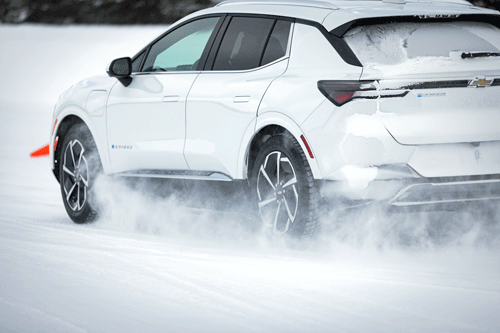
This is where the performance gap narrowed considerably. The Continental remained Michelin’s closest rival, offering excellent lateral stability and predictable behaviour at the limit. The Nokian RS EV impressed with smoothness and composure, particularly through longer sweepers, reflecting its efficiency-oriented tuning.
What set the Michelin apart was balance. Braking zones were shorter and more consistent, turn-in felt slightly more progressive, and, crucially, breakaway was easier to manage. When pushed beyond grip, the Michelin communicated clearly and recovered with less drama, making it the most confidence-inspiring tire of the trio on this surface.
Worn-Tire Reality Check: Michelin vs. Bridgestone
The Bridgestone Blizzak WS90 entered the test under very specific conditions. Rather than new-tire comparisons, Michelin elected to evaluate worn-tire performance, a scenario many real-world drivers experience by the end of winter.
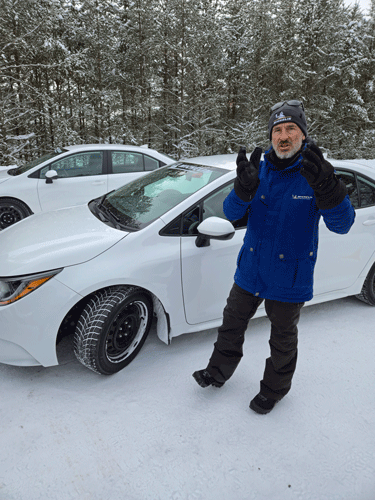
Both the Michelin X-Ice Snow+ and Bridgestone Blizzak WS90 were shaved to 4/32s, the point where a winter tire is approaching the end of its effective life but is not yet legally or practically finished. Testing took place on a wooded off-road course in deep, but not extreme, snow.
Here, the Michelin demonstrated a meaningful advantage in maintaining traction and stability as tread depth diminished. The Blizzak, known for its strong new-tire grip, showed more pronounced falloff, requiring additional throttle management and exhibiting reduced bite when restarting on uneven terrain.
This portion of the test reinforced one of Michelin’s core claims: that performance is not just about peak grip when new, but confidence maintained over time.
Beyond Grip: The Bigger Picture
Across all scenarios, the Michelin X-Ice Snow+ stood out for its consistency. Road noise remained impressively low between test zones, steering response stayed predictable as temperatures fluctuated, and the tire never felt optimized for one condition at the expense of another.
The Continental VikingContact 8 proved itself a formidable rival, particularly on ice and packed snow. The Nokian RS EV delivered excellent refinement and stability, especially for EV drivers prioritizing efficiency. The Bridgestone Blizzak WS90 remained approachable and confidence-building, though its strengths were most evident earlier in its tread life.
Verdict
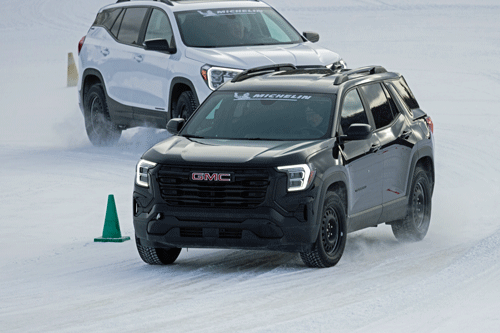
There are no weak tires here. Each excels in specific areas, and any would serve Canadian drivers well in winter.
But tested where it matters; in targeted, back-to-back conditions, the Michelin X-Ice Snow+ emerged as the most complete winter tire of the group. Not because it dominated every test, but because it delivered the highest level of confidence across the widest range of scenarios, including when worn.
In winter, confidence is everything. At Mecaglisse, Michelin earned it.
Compare-At-A-Glance
Premium Studless Winter Tires – Tested at Mecaglisse
| Tire | Extreme Deep Snow (Off-Road) | Snow & Ice Road Course | Worn Tire Performance (4/32s) | Overall Character |
|---|---|---|---|---|
| Michelin X-Ice Snow+ | Excellent – strongest forward bite and momentum retention in back-to-back testing vs Continental | Excellent – shortest braking zones, progressive breakaway, best balance vs Continental & Nokian | Excellent – retained traction and stability when shaved | Most complete performer; confidence maintained across conditions and wear |
| Continental VikingContact 8 | Very Good – close to Michelin, slight hesitation when restarting in extreme depth | Very Good – strong lateral grip, predictable at the limit | Not evaluated | Ice and packed-snow specialist with strong composure |
| Nokian Hakkapeliitta RS EV | Not evaluated | Very Good – smooth, stable, efficiency-oriented tuning | Not evaluated | Refined and composed, especially appealing for EV drivers |
| Bridgestone Blizzak WS90 | Not evaluated | Not evaluated | Good – noticeable grip falloff vs Michelin at 4/32s | Strong new-tire performance; grip diminishes more quickly with wear |
Test Notes:
-
Extreme deep snow testing was conducted back-to-back between Michelin and Continental only
-
Snow & ice road course testing compared Michelin vs Continental and Nokian
-
Worn-tire testing was conducted Michelin vs Bridgestone only, both shaved to 4/32s
Winter Tire Wear: What Canadian Drivers Should Know
In Canada, a tire is considered legally worn out at 2/32 of an inch of remaining tread depth. At that point, the tire has reached the minimum allowable depth for road use; but for winter driving, that threshold comes far too late.
Most winter tire manufacturers and safety experts recommend replacing winter tires closer to 4/32s, as snow traction drops off sharply beyond that point. The deep grooves and siping that help evacuate snow and bite into ice simply can’t do their job once tread depth is reduced.
That’s why worn-tire testing matters. In real-world Canadian driving, many winter tires spend their final season operating between 4/32s and 2/32s. A tire that maintains grip and braking confidence deeper into its life cycle doesn’t just perform better, it keeps drivers safer for longer.
Bottom line: Legal doesn’t always mean optimal. For winter tires, earlier replacement equals greater peace of mind.