


Editor’s note: This story was first published in Vicarious magazine and has been adapted for vicariousmag.com.
For many, the history is well known: a somewhat miffed Ferruccio Lamborghini, upset that the Ferrari he recently purchased wasn’t performing as he thought it should, tried to get Enzo Ferrari himself to grant him an audience, but to no avail. So, Lamborghini – astrological sign Taurus, thought “well, perhaps I can do it better.” As the legend goes, Mr. Ferrari eventually said something along the lines of “oh yeah? Prove it” and with that the Miura, the first super sports car, was born.
That, however, was three years after Lamborghini debuted the “Automobili” part of his tractor empire and almost two decades after he built his first tractor factory in Italy’s Cento commune, his birthplace. The Miura wasn’t the first car he created, either; that was the front-engine 350 GT, a grand tourer he built because when he first started building cars, the goal was comfortable, powerful models that could cover long distances. After all; that’s what Ferrari was doing and apparently – if Lamborghini’s frustrations at the gates of Maranello were any indication – not doing especially well. It was the new kid on the block’s time to shine.
A few changes in ownership and a bankruptcy in 1978 brings us to today, and our visit to Automobili Lamborghini S.p.A. in the heart of Italy’s Modena region.
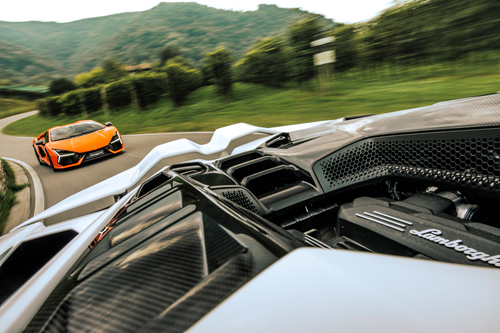
All low and glassy and with flags galore – Lamborghini here, European Union there, Lamborghini here again, Italy there – the facility is a visual testament to just how far this brand has come. Indeed, the fact that it’s grown from 10,000 square metres in 1963 to 182,000 m2 in 2025 is a properly tangible testament to Lamborghini’s progress through the years. They used to produce one car a day; now they produce 30 Urus SUVs alone per day and that’s just one of three models they currently build, along with the Revuelto hybrid hypercar and Huracàn supercar. The additions over the years have added a paint shop, the ability to build three models at once and an entire wing dedicated to the production and application of carbon fibre.
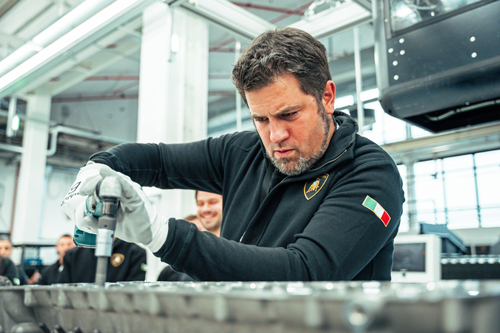
Vicarious Senior Editor Dan Heyman Assembles Lamborghini Revuelto
Vicarious Senior Editor Dan Heyman Assembles Lamborghini Revuelto
Vicarious Senior Editor Dan Heyman Assembles Lamborghini Revuelto
Vicarious Senior Editor Dan Heyman Assembles Lamborghini Revuelto
Vicarious Senior Editor Dan Heyman Assembles Lamborghini Revuelto
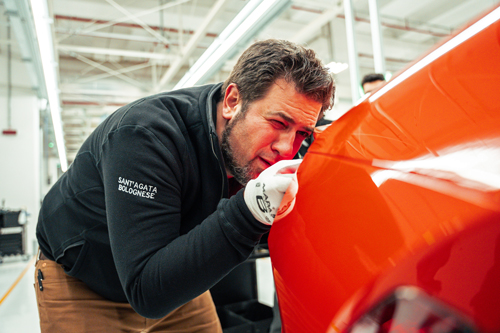
Vicarious Senior Editor Dan Heyman Assembles Lamborghini Revuelto
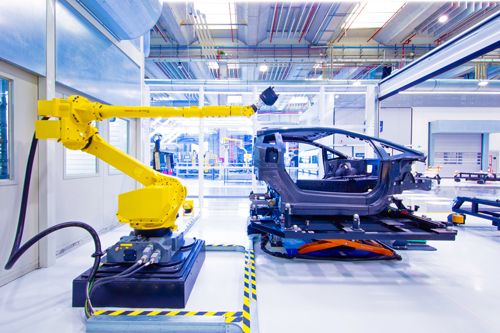
Carbon fibre, once a material used for the occasional accessory or maybe – maybe – a set of wheels, now serves as the basis for the entire monocoque of many Lambos, a trend that started with the Aventador in 2011. Since carbon fibre doesn’t exactly grow on trees, it has to be made and so Lamborghini has essentially vertically integrated the whole process. They craft their own material, then apply it using anywhere from 2,500 to 5,000 tonnes of pressure, layer by layer (the Revuelto’s roof alone is constructed from seven layers of the material) until it’s perfect to within 10ths of a millimetre, anywhere and everywhere on the car. To prove just how precise it all was, we were given a chance to craft a scale model of a Revuelto in carbon fibre, using the same technique the workers do when making parts. Think mortar and pestle, just with a little more carbon.
Lamborghini Composite Centre
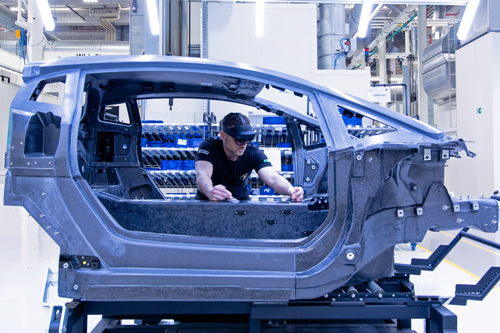
Lamborghini Composite Centre
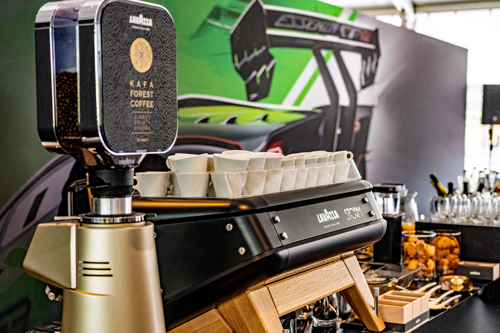
Lamborghini Composite Centre Lavazza Coffee Station
While it has its industrial side to be sure, the area in the immediate vicinity of the plant is all agricultural – Ferrucio was originally a tractor maker, remember? So, for this growth to happen, it had to do so with an eye to the environment.
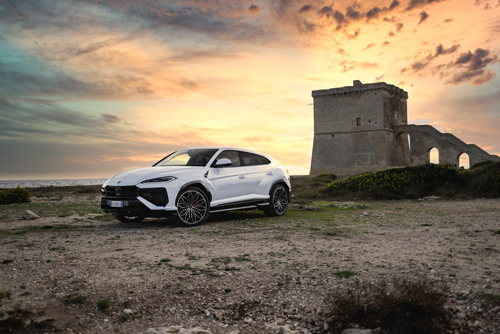
2025 Lamborghini Urus SE
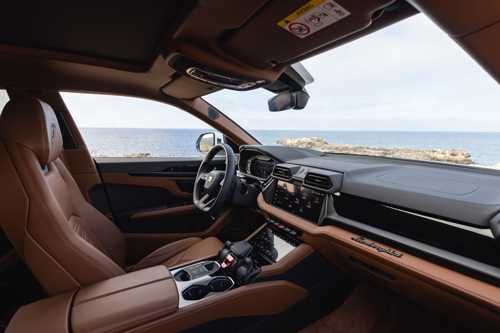
2025 Lamborghini Urus SE
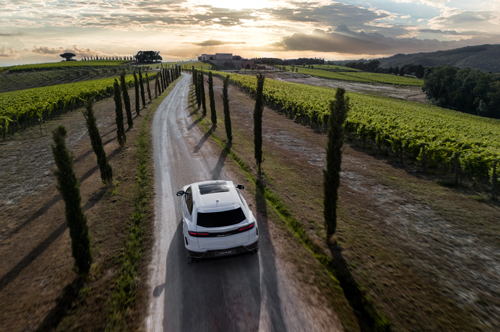
2025 Honda CR-V Hybrid
“We have the responsibility to preserve the environment and be as un-invasive as possible,” said Ranieri Niccoli, Chief Manufacturing Officer. “In 2015, [the plant was] the first to be certified by the Det Norske Veritas as carbon neutral.” In case you’re asking: Lamborghini manufacturing was the first in the world to be given that designation. The use of biomethane gas instead of natural gas for power (about 50 per cent of the facility runs on biomethane), a closed electricity, heating and cooling facility and more use of water-based paint have all contributed to reducing Lamborghini’s carbon footprint. Even the carbon fibre operation is in on the deal, with Lamborghini closing in on using recycled carbon (carbon starts as a sheet, so there’s always cut waste) for certain body and chassis elements going forward.
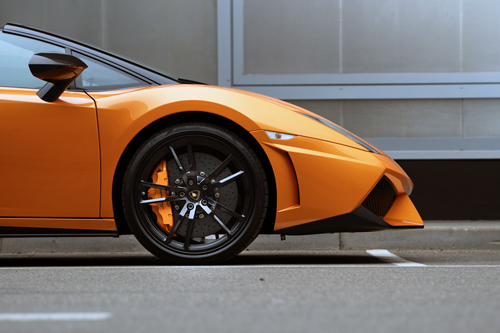
They’ve also developed an off-site greenspace that features 10,000 freshly planted oaks, 13 beehives, a wellness/fitness trail and, when the new Temerario arrives later this year, Lamborghini’s whole line-up will be electrified. You can see just how far they plan on taking this.
Even with all of this added tech, though, the focus at Lamborghini S.p.A. remains on the folks putting the time in. The factory floor is just as modern as you’d imagine of a 21st century car manufacturer – computer kiosks everywhere, every screw, nut and bolt catalogued and accessed via handled remotes – if you take a bolt, you have to scan for it – and even a robot or two. This, though, is all there to support those applying the elbow grease.
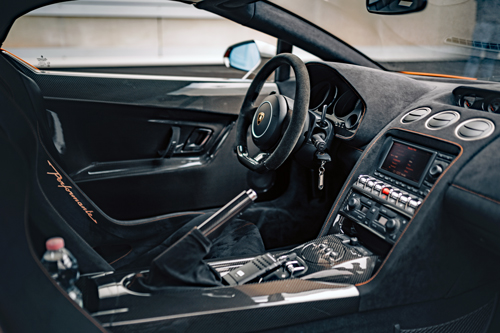
“Digitalization is not in contrast with craftsmanship,” said Niccoli. “It is helping our people to work and to be focused. Robots are only used for activities which are highly repetitive and where we need their extreme precision.
“The value is that the workers are building the car with their hands.”
It’s great that he says that, but really, for something this sacred you kind of have to feel it…don’t you? Well, it seems that Lamborghini would agree because not long after our talk, Niccoli sent us right out on to the factory floor to get kitted out and get to work.
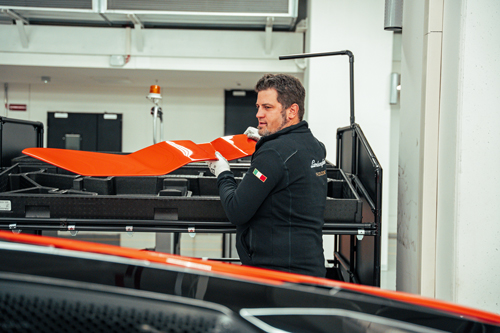
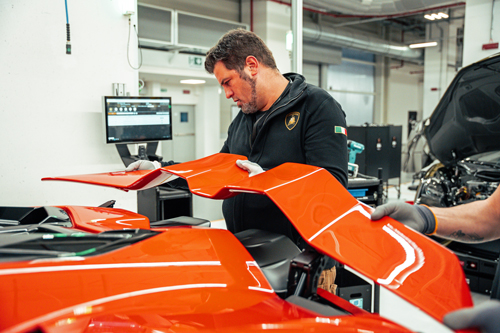
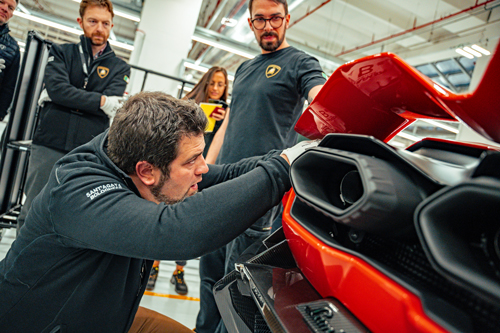
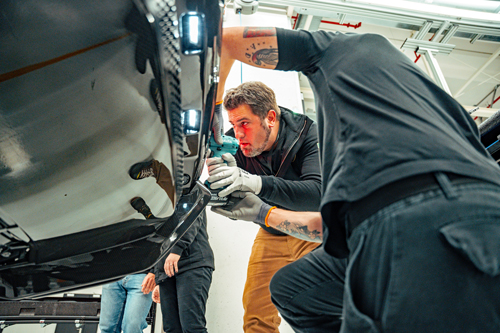
With that, we donned our official S.p.A. abbigliamento da operaio gear (seriously – you can’t buy these sweaters anywhere) and were tasked with everything from helping build a Revuelto’s engine, to installing its taillights and even attaching its active spoiler, finished in that oh-so-perfect carbon fibre we’d been hearing about. This was no development mule, either; this was a real customer’s car and Lamborghini even said they would send us the VIN number.
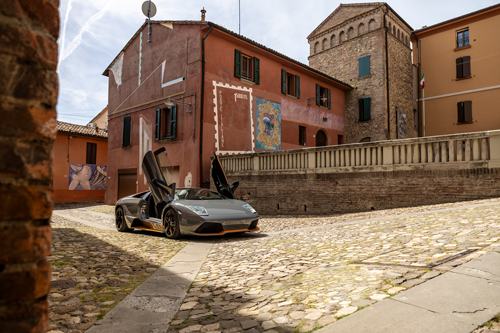
To be out on that floor – for as brief a visit as it was – and to be handling those tools and parts presented a thrill I hadn’t at all expected. I’ve driven Lambos before – including the Revuelto – but to see and help one come into being? That’s another ball game.
Oh, and they let us keep the shirts.