


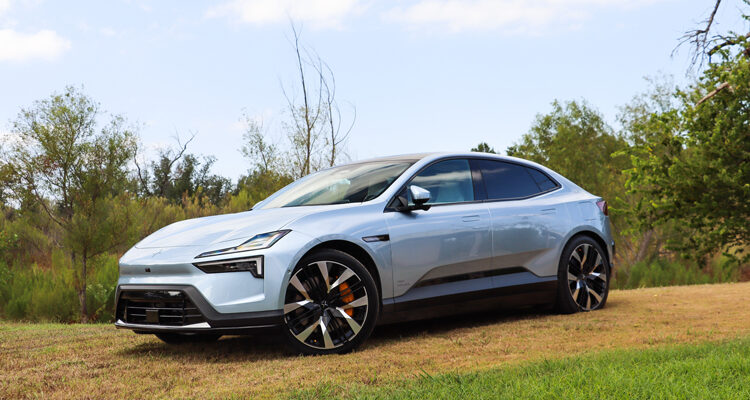
Austin, TX — While the Polestar 4 has been seen in other markets for just under a year now, the 2026 model year represents the first time we’ve seen Polestar’s latest on our shores. It is an EV with a checkered backstory; for starters, it’s somewhat uncategorized – Polestar is calling it a D-segment crossover-coupe, which is somewhat ambiguous. It’s also a car/crossover from a Swedish company that’s partly owned by a Chinese company and is assembled in South Korea in a plant formerly used to build Renaults. That’s because the Polestar 4 rides on a new platform that Volvo/Polestar’s plant in South Carolina – where the 4’s Polestar 3 SUV precursor is built, alongside the Volvo EX90 – isn’t equipped to build. So, in order to avoid certain US import complications on Chinese-built vehicles that have been well documented lo these last 7-8 months, it was time to find an alternative.
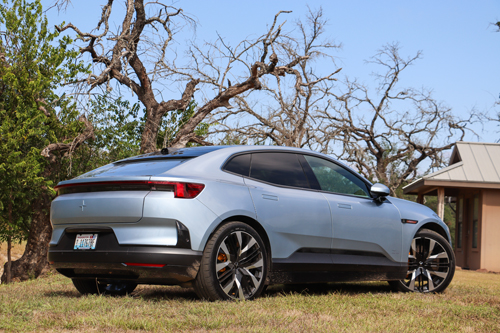
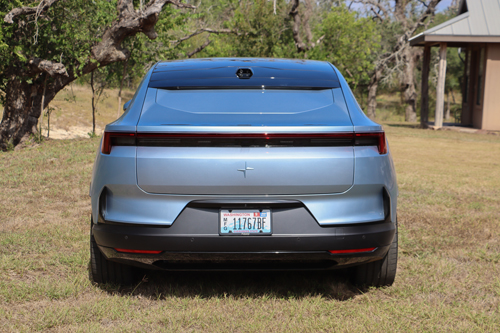
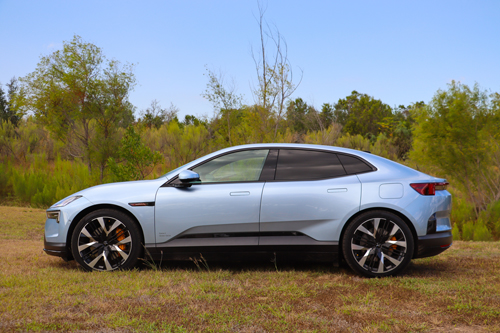
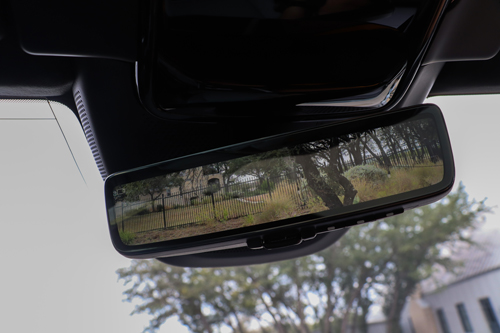
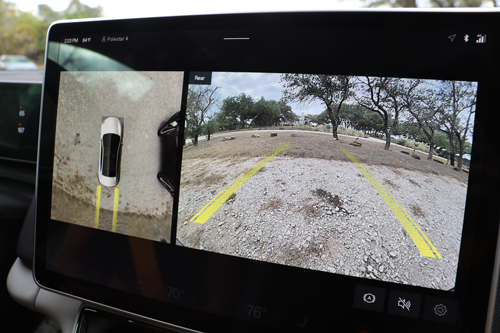
Nevertheless, it’s here now and it looks spectacular. It also looks like a bit of a trompe d’oeuil thanks to its having no rear window and that’s no trick; there actually is no rear window so a standard digital rear-view mirror is necessary. Why? Well, it makes for a unique look to be sure and the view out of a digital rear-view mirror is inherently better thanks to there being no chance of rear passenger’s blocking the driver’s view rearwards.
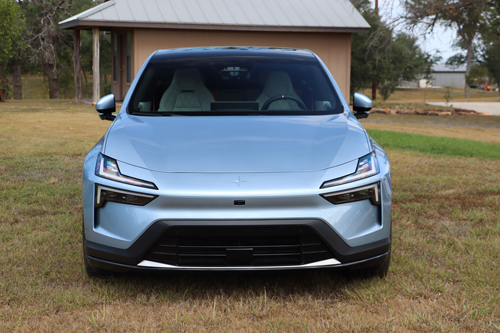
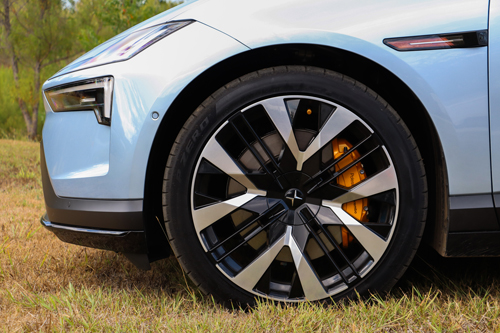
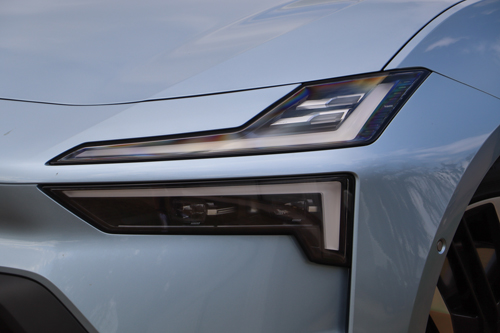
Other than that interesting detail, we find beautiful 22-inch rims (with 20 and 21-inch items coming as standard) shrouding gold brake calipers (a callback to the days when Polestar was tuning Volvos), new Electron Blue metallic paint, dual-tier headlights and full-width taillight bar. It gets a low, wide stance that says four-door coupe more than a crossover of any kind and darned if isn’t one of the most unique-looking EVs found in North America today.
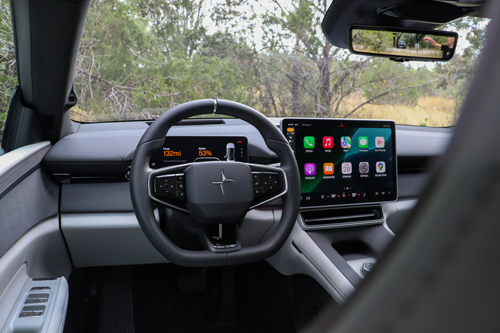
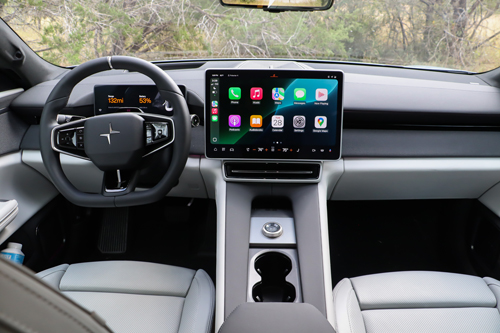
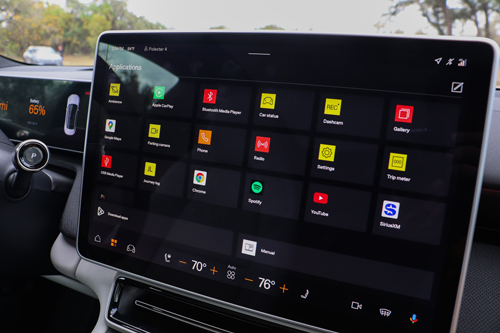
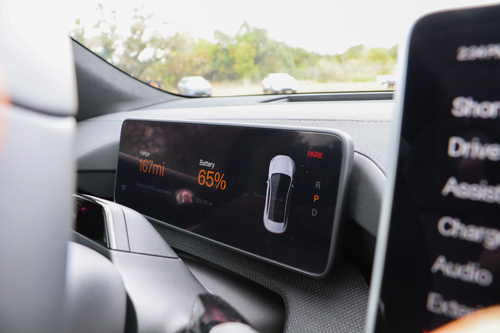
Inside, as has become the Polestar way, we find a low-clutter interior finished in Swedish-modern style and with a dash dominated by a 15.4” touch display. Almost everything you can do in the car starts here; from opening the glovebox to dimming the optional variable-opacity full-length glass roof and choosing from between various chassis and powertrain adjustments, it’s all done through this responsive display. Built-in Google Maps is also featured, with fonts that have been changed to match the custom typography used elsewhere in the system. There’s also wireless Apple CarPlay, charging and a quartet of USB-C ports (two up front, two in the back).
The only actual buttons found in the cockpit include a volume knob/on-off button and some buttons mounted to the steering wheel. These are not haptic, either; they are actual hard-touch buttons for your adaptive cruise control as well as to perform steering wheel and exterior mirror adjustments. We’ve seen that before in Polestar products, but they’ve made it a little easier to do now with slightly less redundancies. Still; I’d prefer traditional mirror/wheel controls as they are a little easier to use. Of course, most owners will adjust these once and likely never deal with them again and the settings can be mapped to driver profiles. In fact, as soon as you make an adjustment, the system asks you if you want to save the settings because there aren’t your traditional 1-2 seat setting buttons found in your typical car or crossover.
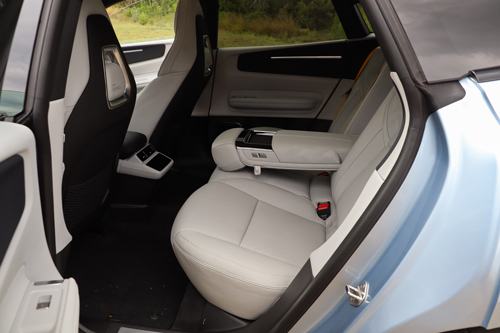
Speaking of seats: contrary to what you might believe (what I believed, in fact) upon encountering the Polestar 4 with its aggressively-raked roofline, the rear seat isn’t cramped but roomy in terms of both headroom and legroom. The rear seatbacks also power recline with the push of a button mounted to the centre armrest — where you’ll also find a tacky surface for your phone as well as two retractable cupholders.

2026 Polestar 4
2026 Polestar 4
2026 Polestar 4
2026 Polestar 4
2026 Polestar 4

2026 Polestar 4
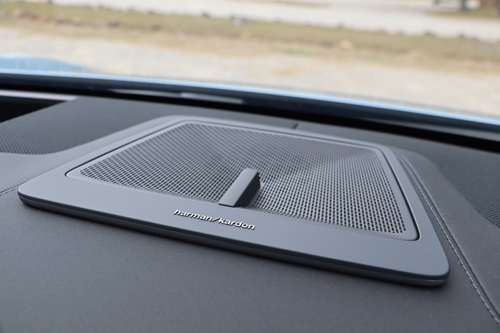
Another add in our fully-loaded tester is a 16-speaker Harmon Kardon audio (12 speakers come as standard; the package adds a speaker into each of the four headrests). You wouldn’t know it from looking inside the cockpit, however; many of the speakers are hidden behind fabric panels. Visible or not, it’s a fantastic system whose depths can be appreciated even by non-audiophiles like yours truly. Also hidden behind panels include some ambient lighting that changes depending on which of the interior themes you choose. Themes that, in a unique twist, are based around planets within the solar system. Red for the sun, blue for Uranus et cetera and no, Pluto didn’t make the cut.
There’s also Nappa leather, massaging front seats and digital rear climate control system. It brings the total to roughly $95,000 in Canada but the starting price for the Polestar 4 comes in at $64,999 for the single-motor long-range model and $69,999 for the more powerful dual-motor AWD version. The former makes 272 horsepower and 253 pound-feet of torque, with the latter making 544 hp and 506 lb-ft. The range difference between the two is only about 50 km (450 km and 499 km for the long range), but the power gap is much larger, making the $5,000 premium easier to justify.
Especially once you step on it for the first time, which will have you and your occupants’ shoulders and lower back planted firmly into the backrest as you sprint to 100 km/h in just under four seconds. That’s darn fast for a 5,000 lb.-plus EV and it makes for a darn fun drive.
The feeling is amplified if you choose the more powerful of the two available drive modes – dubbed “range” and “performance” – or if you’d prefer, individually set the throttle response to one of three levels. You can also adjust the steering feel, regen level, suspension firmness and how strict the ESC is, all from one handy menu.
As impressive as the speed is, the ride and handling may be even more so. Polestar is adamant that they didn’t want to just deliver a hi-po EV with a big battery. According to Polestar engineer Christian Samson, anyone can do that. The real trick is having the ability to make one that can also be driven through the corners and rides comfortably in the city. An ultra-smooth departure from our hotel in the centre of Austin – complete with cracked concrete and tarmac heaves – immediately solidified the 4’s premium ride attributes. Its planted attitude through the foothills around Austin, meanwhile, delivered on the promise made by the athletic styling. Even without self-levelling air suspension and using traditional anti-roll bars, the 4 stayed flat through fast sweepers and tighter hairpins alike and was able to swing gamely through the bends. The hairpins are where the brake-based torque vectoring comes into play; the brakes automatically get applied to the inside rear wheel to help swing the 4 through the bends, at which point the power gets driven through the 255-section tires into the tarmac below to help you with the perfect hole shot out of bends.
2026 Polestar 4
2026 Polestar 4
2026 Polestar 4
2026 Polestar 4
2026 Polestar 4
2026 Polestar 4
2026 Polestar 4

2026 Polestar 4
2026 Polestar 4
That’s the dual-motor model; a quick drive in the single-motor RWD model returned a ride that was equally impressive and though it is down on power, it’s not something I’d describe as “slow”. In fact, the RWD provides a slight boost in the handling department with slightly more steering feel, due in part to less weight being up front and not having to accommodate for the bulk of a second EV motor.
As good as the RWD is, I think I’d have a hard time not going with the AWD. It’s got the power and the traction advantage for the adverse conditions often found in Canada. I’d go with the dual-motor, perhaps save a couple of grand by skipping the adjustable moonroof and Nappa (I’d opt instead for a new high-performance textile inspired by outdoor hiking and workout gear) and happily be on my way.