


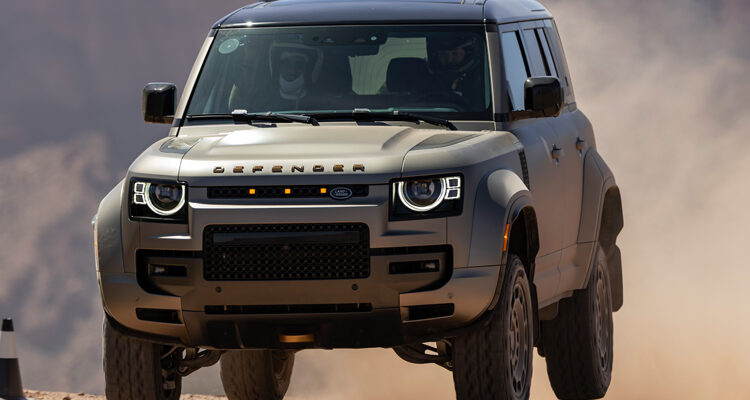
Gateway, CO — The Defender – it’s just “Defender”, not “Land Rover Defender” anymore – is remarkable in any of its three forms: 90, 110 or 130. It has a unique shape often copied but never really equalled and it hails from a line of hard-working off-road jeeps that have rumbled, scrambled, clawed and mudbathed their way into the hearts and minds of enthusiasts worldwide. For many, it was a sad day when the line ended in North America after the 1997 model year so it is little surprise that now, almost 20 years later, the Defender brand is one of the strongest pillars in the Jaguar-Land Rover (JLR) conglomerate.
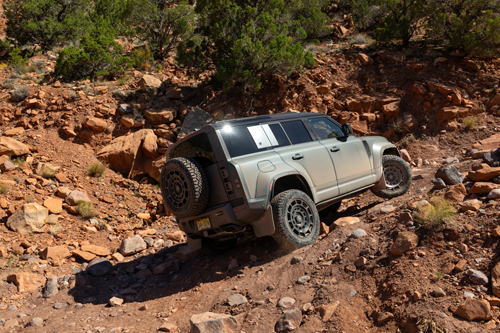
Of course, one of the biggest attractions of the Defender has always been its modularity; there was a pickup version, various wheelbases, a van version, convertible and on and on. It was a simple platform, and it was tweaked – incessantly. The new truck is more complicated with electronic wizadry, a bigger focus on comfort and the need to do justice to the luxury SUV segment in which it now resides but that hasn’t stopped Defender from adding a little variety to the platform. Case in point: the all-new OCTA.
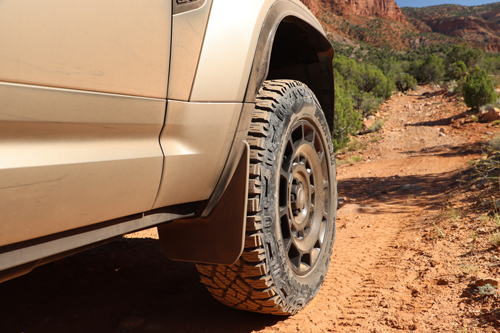
While the OCTA is clearly a Defender 110 variant, there’s so much more going on underneath it all. For starters: just look at those wheels and tires.
Defender turned to Goodyear to develop an extra-durable tire for the OCTA, and they answered the bell by embedding Kevlar – a material used in everything from boat sails to bulletproof vests — into the tires’ sidewalls. That makes it very hard for sharp rocks to punch through, which is a big deal when off-roading or navigating potholed Canadian streets.
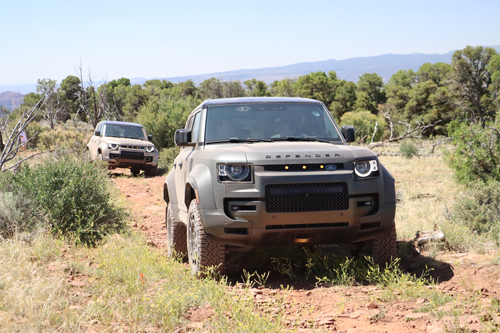
Under the hood things get more interesting still. The OCTA is the first Defender model to get a new 4.4-litre twin-turbocharged V8 engine. It’s good for 626 horsepower and 553 pound-feet of torque, both healthy increases over the 5.0L supercharged V8 the Defender currently uses.
It’s an incredible engine that revs quickly and gives you its full slug of torque at just 1,400 rpm. That’s the kind of quick power delivery you want when off-roading as it helps pull you through steep, rough situations.
To prove its worth, we went for a 4,000-foot climb on unforgiving mountain trails littered with rocks (average size = a softball), loose gravel and jagged outcroppings poised to tear many a tire’s sidewall and gash many a fender. Even the desert bushes are foreboding, their lives hard lived in harsh, dry, hot conditions forcing them to develop branches with arthritic tendrils that sound like nails on a chalkboard as they “brush” – if you can call it that – against the fenders, doors and roofs of our OCTA.
With a selection of drive modes (we chose Rock Crawl for this jaunt) and an all-new “6D Dynamic” suspension system that provides massive wheel articulation, the OCTA clambered over everything with no complaint. To help further instill confidence, the central display inside can be set to show a camera that looks over each front wheel. That’s handy when you have a panel-shearing rock wall on one side, and about a foot between said wheel and a 100-foot drop on the other.
Even through a three-foot-deep river crossing in “Wade” mode, the OCTA ploughed on, the powerful engine having no problem neutralising the water resistance. Defender says the OCTA can wade in up to a metre of water and I have no reason to think otherwise.
As a bit of a cherry on top of all of this, we were also unleashed on a fast off-road course to put the OCTA’s desert-running bona fides to the test. Not only were we going to drive it, but we were also going to be given rides around a purpose-built course (Jumps! Sand! Drifts!) by none other than racing driver Davy Jones. He counts wins at Le Mans and podium finishes in the Indy Racing League and the Indianapolis 500 among his many accomplishments. The fast off-road course did have me holding on that much tighter only because I wanted to see what the OCTA could do, how far I could push it. One of the drive modes is called “OCTA”, and it allows for just a little more slip, and a little more ability to control the rear end with the throttle. It was great, although Jones was surprised I didn’t push it a little harder over the big jump at the end…
Speaking of Jones: me driving is one thing, but put the OCTA in the hands of a seasoned racing driver and things get much more rapid. Even then, it seemed that no matter what Jones threw at the OCTA, it handled it well, smoothly drifting through long sweepers, and powering out of slow corners, the computers shuffling torque about to get as quick an exit as possible. In this state, the OCTA feels less the luxury SUV, and more the Baja blaster and wouldn’t you know it? A very-near-to-stock version of the OCTA will be competing at the 2026 Paris-Dakar Rally as part of a factory-backed effort.
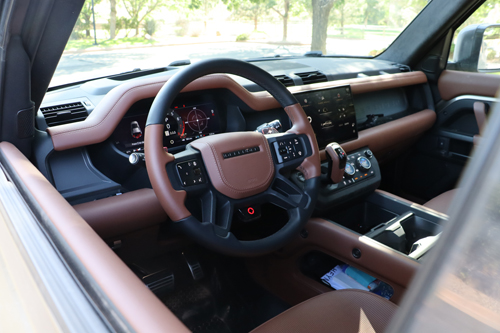
2025 Defender OCTA
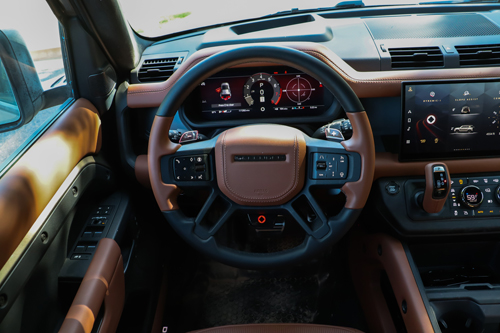
2025 Defender OCTA
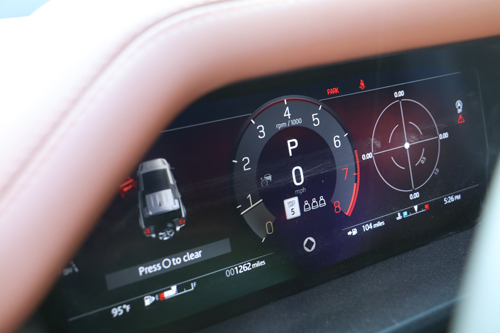
2025 Defender OCTA
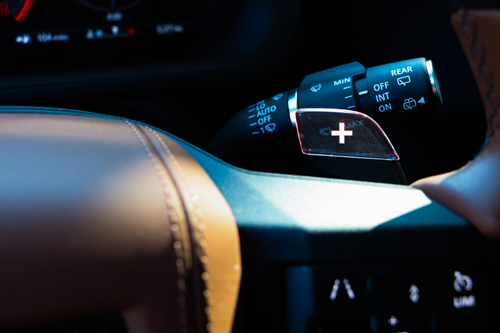
2025 Defender OCTA
2025 Defender OCTA
2025 Defender OCTA
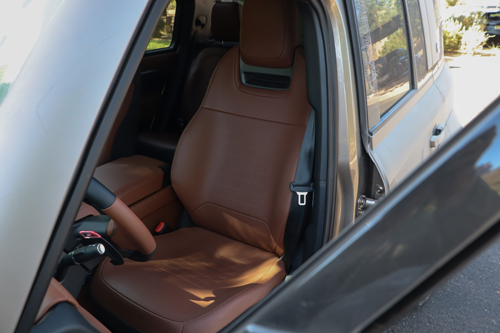
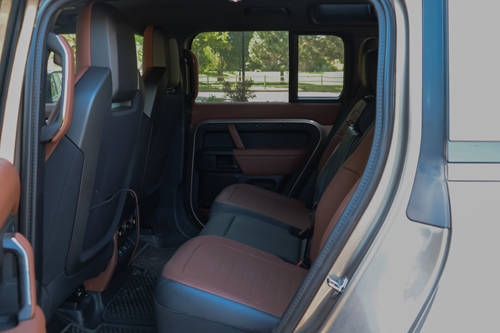
Back on the road – surprisingly quiet and comfortable, even with knobby off-road tires – I had the chance to enjoy the interior environs of this most hardcore of showroom-spec Defenders. The OCTA has heated and cooled front seats, heated rear seats (cooled if you spec the captain’s chairs), Meridian audio, digital rear-view mirror, automatic climate control, 11.4” infotainment display and the very unique Body and Soul Seats (BASS).
More than just being heated, cooled and providing a massage feature, BASS seats – developed in conjunction with Subpac, a Toronto-based company – are tuned to vibrate with your music. Or, they can use the seat’s built-in actuators and heating controls to help provide a relaxing environment if you need a break.
Those seats present a pleasing ying to the wild yang that defines the rest of the OCTA experience. It really is the wild thing of the current Defender line-up and yet another testament to just how far the company can push this platform. It’s a tonne of fun and while it doesn’t come cheap and is very much kind of a “halo” vehicle, there really isn’t much else like it out there.